The exit from the wood is abrupt. One minute you are walking through commercial forestry, the next, one of the finest views in the Grampians lies before you. Corrie Fee may lack the dramatic architectural splendours of Lochnagar or the Garbh Choire of Beinn a' Bhuird, but here you will find one of the best examples of a glaciated corrie in Scotland. The eye is immediately drawn to the waterfall tumbling in steps down the back wall of the cirque to the flats where the burn meanders through mounds of glacial debris. The descent into the corrie from the west provides a remarkable view of these mounds; capped with heather, they stand out clearly from the lighter coloured grasses which surround them. Unlike the granite of the Cairngorms, the rocks of Corrie Fee produce fertile soil which encourages the growth of rare alpine plants; the area is an important site for montane willow scrub. With luck, you will see an eagle patrolling its territory.
The corrie is ringed by cliffs, from Craig Rennet in the north to Coire Shalloch in the south. The fertile soil has led to the crags being festooned with vegetation which has severely limited the number of rock climbs. Those that do exist are of the old-fashioned variety; if you enjoy pulling on heather, this is the place for you. In winter, it is a different story. The vegetation can be an advantage, and the gullies and buttresses, particularly on the south side, provide well-defined lines. A few examples apart, Corrie Fee is home to lower-grade routes. It is a good place to learn the craft of winter climbing, or to escape to when the higher hills are deep in powder.
It first caught my eye while I was descending the corrie as dusk was falling one winter afternoon. I had stopped to scan the cliffs and enjoy the memories: Look C, B Gully Chimney, and the rest. To the right of A Gully, and a little way up it, I noticed a band of snow leading up and rightwards. From its top, snow fields curved up leftwards in a bow shape above the steepest walls in A Gully. I was intrigued; I knew no such line was in the guidebook, but surely something so obvious had been climbed. Back at home I checked other sources but could find no record. I determined to give it a look. The snow band appeared to start to the right of the first steep buttress in A Gully. Could it be reached from the gully itself?
|
| Winter Climbing in Coire Fee © G. Allan |
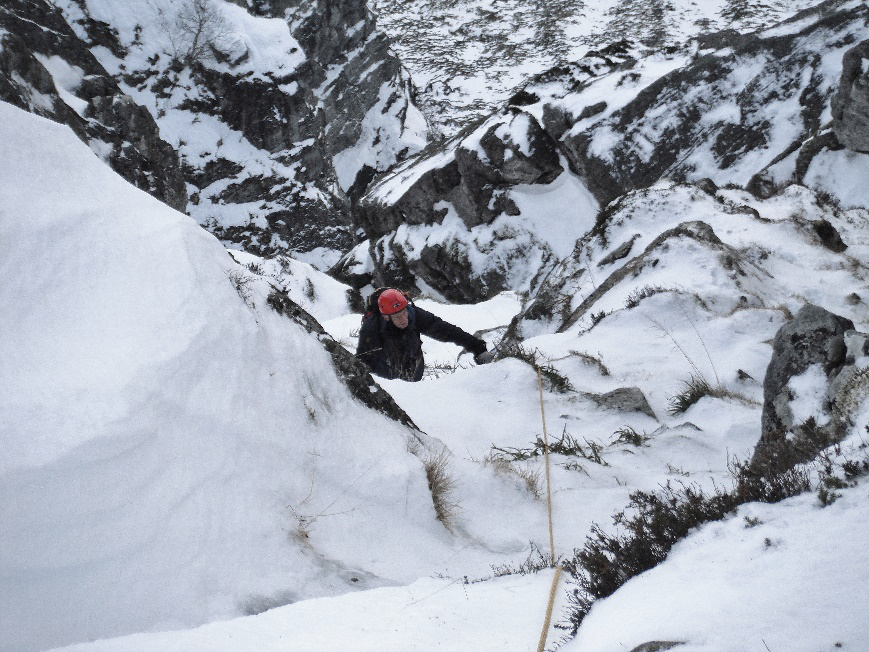
My first attempt got nowhere; heavy snow meant that the gully was out of bounds. My judgement was better the second time, and, filled with anticipation, I cramponed past the buttress. To my delight an inviting narrow gully cut upwards behind the rock and twisted out of sight. The névé was perfect. The white band turned out to be a continuation of the fault and led into a bay, at the back of which was a short wall. Ice can form here, but that day it was too limited to be of use so I attacked the bay's right-hand corner. Crusty snow on vertical heather demanded care. I arrived adjacent to A-B Integrate but the snowfields tempted me up to the left. The snow remained perfect, the climbing simple, and the whole thing was pure pleasure; a small cornice arrived at much too soon.
Scotland still provides innumerable opportunities for routes of this nature: climbs in the lowest grades, climbs of little consequence, climbs which are just fun to do. You can even give them names if you want to. Given all the letters on the cliff, this one had to be Alphabet Soup. Bad weather was forecast but the day was still windless and, with a couple of hours daylight left, I crossed the plateau to take in Mayar.
By the time I reached the head of the glen, gusts of wind were whipping up loose snow and the sky in the west had turned gun-metal grey; the storm would soon arrive. Back at the corrie floor, sheltered from the wind, I stopped to remove my crampons. A sense of calmness and well-being filled me. Bob Dylan has written:
They tell me everything is gonna be all right
But I don´t know what "all right" even means.
But just for that moment everything was all right, and I felt like I was home.
The above article is a slightly amended version of a chapter from Farquhar, G. (ed). A'Chreag Dhearg: Climbing Stories from the Angus Glens. Scottish Mountaineering Press, 2021.
Please let the webmaster know if there are problems with viewing these pages or with the links they contain.